The concept of normalization emerged alongside the study of the normal distribution by Abraham De Moivre, Pierre-Simon Laplace, and Carl Friedrich Gauss from the 18th to the 19th century.
What is data normalization? Data normalization is the process of organizing the columns and labels of a relational database to minimize data redundancy. It structures data so that you store each piece of information in the most logical place and only once. The goal is to make databases more efficient and reliable.
Normalization is an important process in database design that helps improve the database's efficiency, consistency, and accuracy. It makes it easier to manage and maintain the data and ensures that the database is adaptable to changing business needs.
Normalization is the process of structuring a database to reduce redundancy and improve consistency. In simple terms, it breaks large messy tables into smaller, well-organized ones.
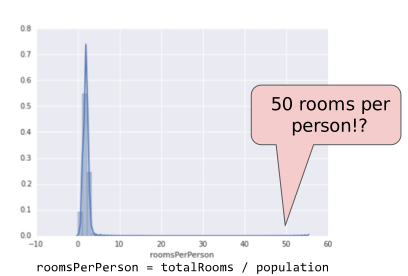
Whether they're dealing with experimental data or large datasets, normalization helps to simplify their data, making it easier to analyze and interpret. They use it to eliminate potential distortions caused by differing scales or units and ensure that their findings are accurate and reliable.
Data normalization is a fundamental technique in data science, machine learning, and database management. It refers to the process of transforming numerical data into a standard range, typically between 0 and 1 (scaling) or around a zero mean with unit standard deviation (standardization).
Database normalization is a database design process that organizes data into specific table structures to improve data integrity, prevent anomalies and reduce redundancy.
Normalization, in general, is all about minimizing data duplication and improving data consistency. It ensures that data is stored in a manner that avoids redundancy and that the stored data is standard in the database.